
Introduction
Every business seeks attention, credibility, and growth. However, many confuse two essential tools: press releases and marketing. While they may seem similar, they serve different purposes and work best when used together. Understanding the distinction helps companies craft more effective communication strategies.
What Is a Press Release?
A press release is an official, newsworthy announcement issued by a company to inform the media and the public. It is factual, objective, and follows a standard journalistic format (headline, dateline, body, quotes, boilerplate, and contact information).
Common uses include:
– Product launches
– Funding rounds or acquisitions
– Executive appointments
– Partnerships and collaborations
– Awards and major milestones
The primary goal is to earn third-party credibility. When journalists cover your press release in outlets like Forbes, TechCrunch, or Bloomberg, it provides independent validation that paid advertising cannot match.
What Is Marketing?
Marketing is a broad discipline focused on promoting products or services to attract customers and drive revenue. It includes advertising, social media campaigns, email marketing, SEO, content marketing, influencer partnerships, paid ads, and more.
Unlike press releases, marketing is:
– Brand-controlled
– Persuasive and benefit-oriented
– Designed to generate direct action (leads, sales, sign-ups)
The main goal is measurable results: clicks, conversions, revenue, and customer acquisition.
Key Differences Between Press Release and Marketing
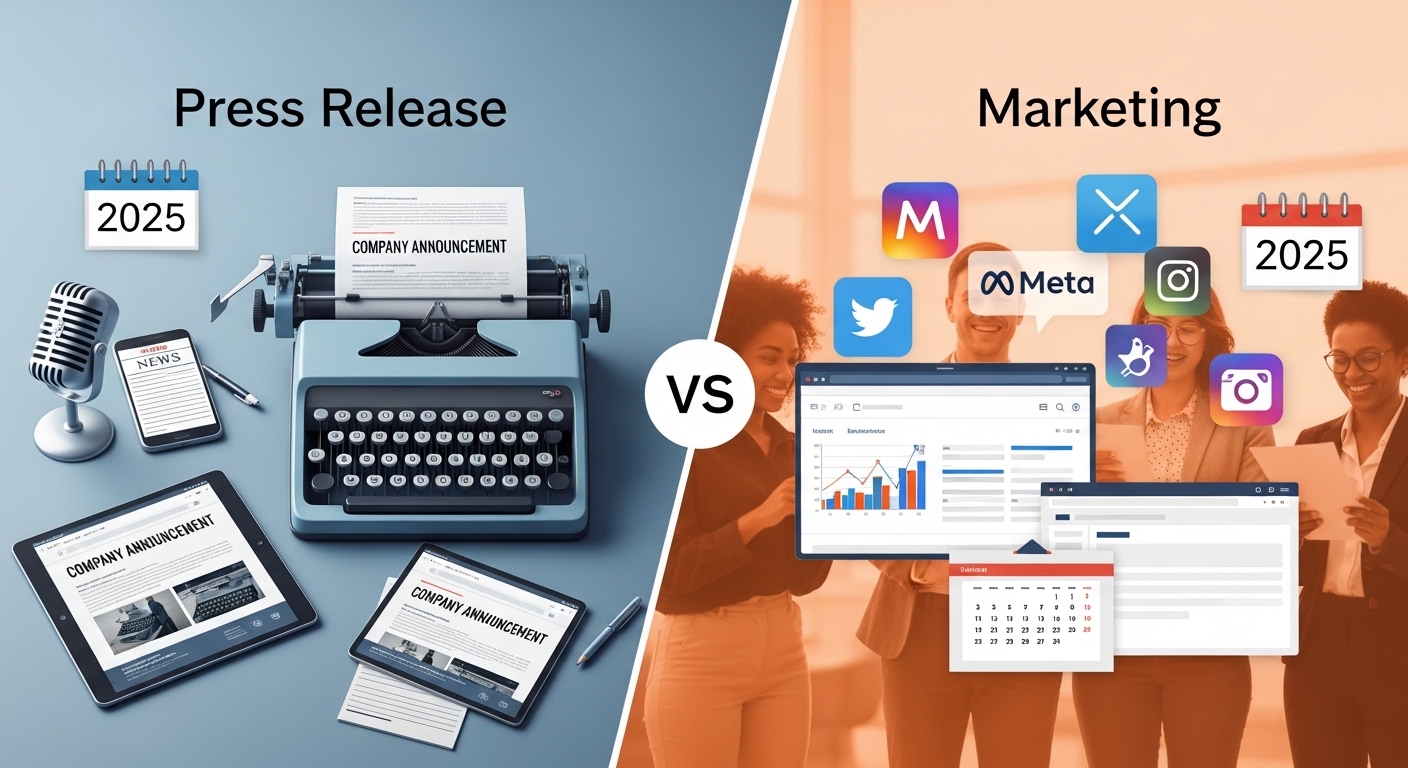
- Primary Goal: Press releases inform the public and build credibility through objective news, while marketing promotes products/services to drive sales and conversions.
- Tone & Style: Press releases use a factual, journalistic tone. Marketing is persuasive, emotional, and benefit-focused.
- Audience: Press releases target journalists, media outlets, investors, and stakeholders. Marketing targets customers and prospects directly.
- Control: With press releases, media outlets decide how the story is covered. Marketing gives you full control over the message, timing, and presentation.
- Success Metrics: Press releases are measured by media pickups, impressions, and brand sentiment. Marketing is measured by click-through rates (CTR), conversions, leads generated, and return on investment (ROI).
- Format: Press releases follow a standard, structured template. Marketing uses diverse formats such as ads, emails, videos, landing pages, and social posts.
How Press Releases and Marketing Work Together
Press releases and marketing are complementary, not competitive.
Best practice example: Product launch strategy
– Issue a press release → Creates media coverage and third-party credibility
– Run marketing campaigns → Use the earned media buzz to amplify reach through targeted ads, email sequences, social posts, and SEO-optimised landing pages
– Result: Credibility + Reach + Conversions
This integrated approach builds trust while converting attention into measurable business results.
Why Both Matter in 2025
In today’s digital landscape, media fragmentation and consumer scepticism make earned media (via press releases) highly valuable for trust-building. At the same time, marketing provides the necessary amplification and direct response capabilities.
Successful companies in 2025 use both strategically:
– Press releases for storytelling and authority
– Marketing for targeting, personalisation, and performance
Conclusion
A press release informs and builds trust through credible third-party coverage, while marketing persuades and drives measurable growth. They are not interchangeable — they are powerful when combined.
The most effective brands in 2025 master both: using press releases to shape the narrative and marketing to amplify it and convert interest into action.
