
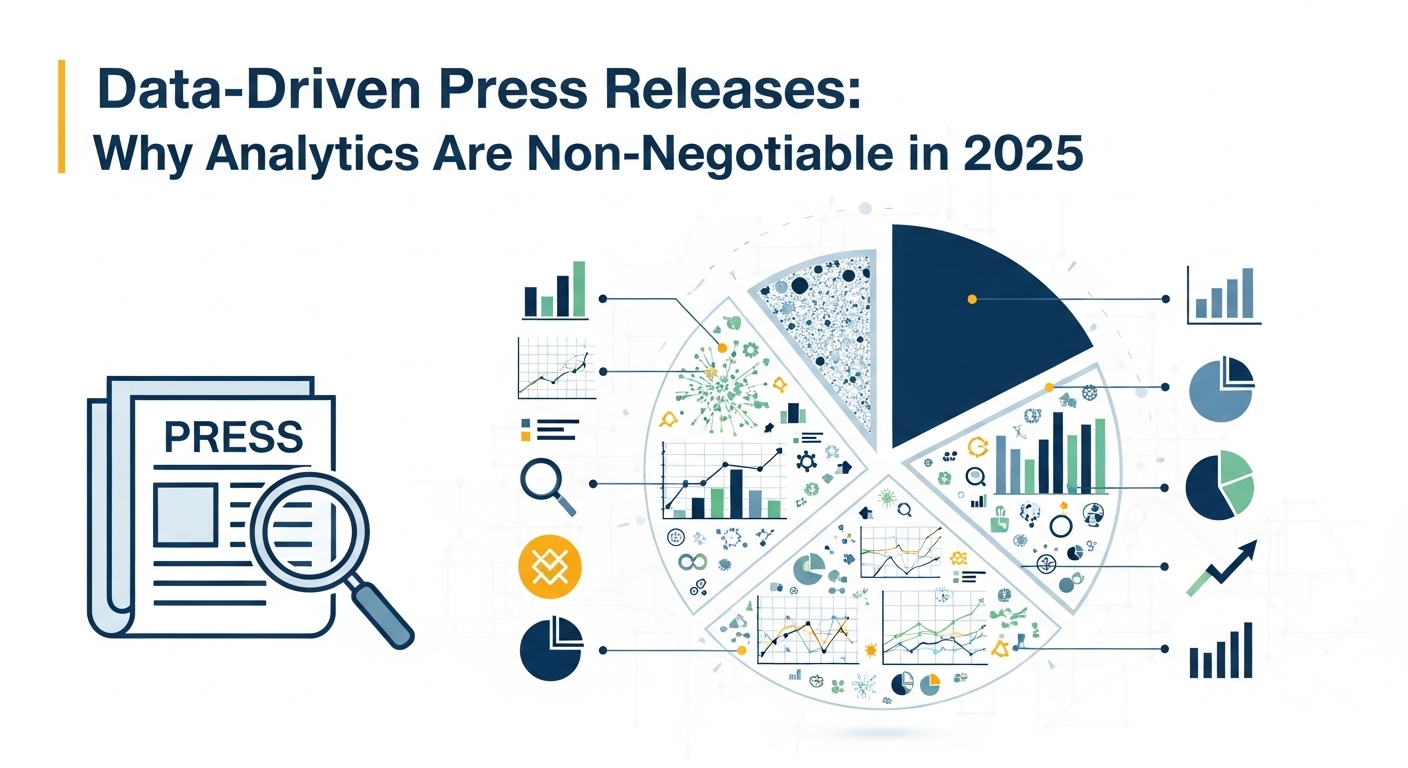
In 2025, the public relations landscape has changed dramatically. Press releases are no longer static announcements distributed to media houses in the hope of coverage. Today, they are strategic, measurable, and performance-driven marketing assets.
Businesses that still rely on traditional PR measurement methods are falling behind. In a digital-first world driven by analytics, ROI tracking, and measurable performance, data-driven press releases are no longer optional — they are essential.
The Shift from Traditional PR to Data-Driven PR
Historically, PR success was defined by one simple metric: media coverage. If a publication picked up your story, the campaign was considered successful.
However, this outdated measurement model fails to answer critical business questions:
- Did the press release drive website traffic?
- Did it generate qualified leads?
- Did users engage with the content?
- Did it influence purchasing decisions?
- Was the brand sentiment positive?
Modern businesses require performance clarity. Brand visibility alone does not justify budget allocation. In 2025, executives expect measurable impact — not assumptions.
This shift has led to the rise of analytics-based press release strategies focused on outcomes rather than outputs.
What Is a Data-Driven Press Release?
A data-driven press release is a strategically crafted announcement designed with measurable business objectives in mind. Instead of focusing solely on distribution volume or publication count, it measures performance across digital channels.
The focus moves from:
Old Model → “How many outlets published it?”
New Model → “What business results did it generate?”
This approach integrates PR with digital marketing analytics, SEO performance tracking, and conversion measurement.
Key Metrics That Define Press Release Success in 2025
To compete in today’s search-driven and performance-based ecosystem, organisations must track the following KPIs:
1. Impressions and Reach
How many unique users viewed the press release across platforms, search engines, and social channels?
Reach gives visibility insights, but must be paired with deeper engagement metrics to understand impact.
2. Click-Through Rate (CTR)
CTR measures how many readers took action after seeing your release. Whether clicking a landing page link, product page, or contact form, this metric reflects audience interest.
A strong headline and compelling CTA significantly improve CTR.
3. Engagement Metrics
Engagement indicates audience interaction:
- Social shares
- Comments
- Downloads
- Time spent on the page
- Scroll depth
High engagement signals relevance and strengthens brand authority.
4. Referral Traffic
Referral traffic measures how much website traffic originated from the press release distribution network.
This metric connects PR directly with website performance and helps evaluate channel effectiveness.
5. Conversions
The most critical KPI.
Conversions may include:
- Lead form submissions
- Product purchases
- Demo bookings
- Newsletter sign-ups
- Event registrations
Without conversion tracking, PR efforts lack business accountability.
6. Sentiment Analysis
Brand perception matters.
Sentiment analysis measures whether the public response is positive, neutral, or negative. Advanced analytics tools now allow real-time reputation tracking, helping companies pivot communication quickly if needed.
Why Analytics in PR Is Non-Negotiable in 2025
ROI Accountability
PR budgets are no longer protected from performance evaluation. Leadership teams expect quantifiable results.
Analytics connects press releases to measurable outcomes like:
- Revenue growth
- Lead acquisition
- Cost per conversion
- Customer acquisition cost
This transparency strengthens stakeholder confidence.
Smarter Campaign Optimisation
Data removes guesswork.
Analytics reveals:
- Which headlines generate higher CTR
- Which keywords rank better on search engines
- Which distribution channels deliver qualified traffic
- Which CTAs drive more conversions
This creates a feedback loop where every campaign improves the next one.
SEO and Organic Search Visibility
Search engine optimisation (SEO) has become a central component of press release strategy.
When optimised correctly, press releases:
- Rank on Google for targeted keywords
- Generate high-quality backlinks
- Increase domain authority
- Drive long-term organic traffic
Google increasingly rewards authoritative, data-rich, well-structured content. A keyword-optimised press release can continue generating traffic months after publication.
Ignoring SEO means ignoring sustainable growth.
PR and Marketing Alignment
Modern marketing is integrated.
Press releases now support:
- Paid advertising campaigns
- Content marketing strategies
- Social media promotions
- Influencer collaborations
- Email marketing funnels
Data ensures message consistency across channels. When analytics show strong engagement in specific demographics or locations, marketing teams can amplify efforts strategically.
Real-Time Reputation Management
Digital conversations happen instantly.
Analytics tools allow companies to:
- Monitor brand mentions
- Track media tone
- Identify negative spikes
- Detect trending discussions
If public sentiment shifts, communication strategies can adjust in real time. This proactive approach protects brand equity.
Why Traditional PR Metrics No Longer Work
Traditional PR relied on:
- Publication count
- Circulation estimates
- Media mentions
- Advertising value equivalency (AVE)
These metrics focus on output volume rather than impact.
They fail to measure:
- Website behavior
- User intent
- Conversion pathways
- Revenue influence
Without behavioural tracking and conversion data, PR becomes an isolated function disconnected from business growth.
In 2025, this is unacceptable.
How to Build a High-Ranking Data-Driven Press Release Strategy
To rank on Google and generate measurable impact, follow this structured approach:
Step 1: Define Clear, Measurable Goals
Before writing, determine the objective:
- Increase organic traffic
- Generate B2B leads
- Launch a product
- Improve keyword ranking
- Drive event registrations
Your goals determine content structure, keyword selection, and tracking setup.
Step 2: Conduct Keyword Research
Identify:
- Primary keyword (e.g., “data-driven press releases”)
- Secondary keywords (PR analytics tools, measurable PR strategy, SEO press release)
- Long-tail keywords (how to measure press release ROI, analytics in PR 2025)
Strategic keyword placement in headings and body improves Google visibility.
Step 3: Optimise Content Structure
Google prioritises readability and structure.
Use:
- Clear H1, H2, H3 headings
- Short paragraphs
- Bullet points
- Internal linking
- Authoritative tone
Search engines favor well-organized, user-friendly content.
Step 4: Use Analytics-Enabled Distribution Platforms
Modern PR platforms offer performance dashboards tracking:
- Impressions
- Geographic reach
- Click data
- Engagement statistics
Choose platforms that integrate with Google Analytics and CRM systems for conversion tracking.
Step 5: Track Beyond Publication
PR performance doesn’t end after distribution.
Monitor:
- Social discussions
- Influencer mentions
- Industry blog pickups
- Brand search volume increases
Holistic tracking provides deeper insight.
Step 6: Analyse, Report, and Improve
Create monthly performance reports covering:
- Traffic impact
- Conversion growth
- Keyword ranking improvement
- Engagement metrics
- Sentiment trends
Data-backed reporting strengthens strategic decision-making.
The Competitive Advantage of Data-Driven PR
Companies that embrace analytics gain:
- Better budget efficiency
- Stronger marketing alignment
- Improved lead quality
- Higher search engine rankings
- Clear ROI visibility
In contrast, businesses relying on outdated PR models struggle to justify spend and scale impact.
Data-driven PR transforms press releases from cost centres into measurable revenue channels.
The Role of AI and Predictive Analytics in PR
In 2025, AI-powered tools further enhance press release performance by:
- Predicting headline performance
- Recommending optimal publishing times
- Identifying trending keywords
- Automating sentiment analysis
Predictive analytics helps brands stay ahead of media cycles and audience behaviour trends.
Companies that leverage AI-backed analytics gain faster insights and competitive dominance.
Final Thoughts:
The era of “publish and pray” PR is over.
Press releases must now function as:
- SEO assets
- Lead generation tools
- Brand authority builders
- Conversion drivers
- Reputation management instruments
Data-driven press releases prove business impact, improve strategic execution, and deliver measurable financial returns.
In a fragmented media landscape shaped by performance marketing and fiscal accountability, analytics are not an enhancement — they are a requirement.
If your press releases are not guided by data, tracking, and optimisation, you are not practising modern public relations.
- Internal linking strategy
- Keyword density optimisation report
- Competitor-style structure, like top-ranking PR websites
Tell me which one you need.
